
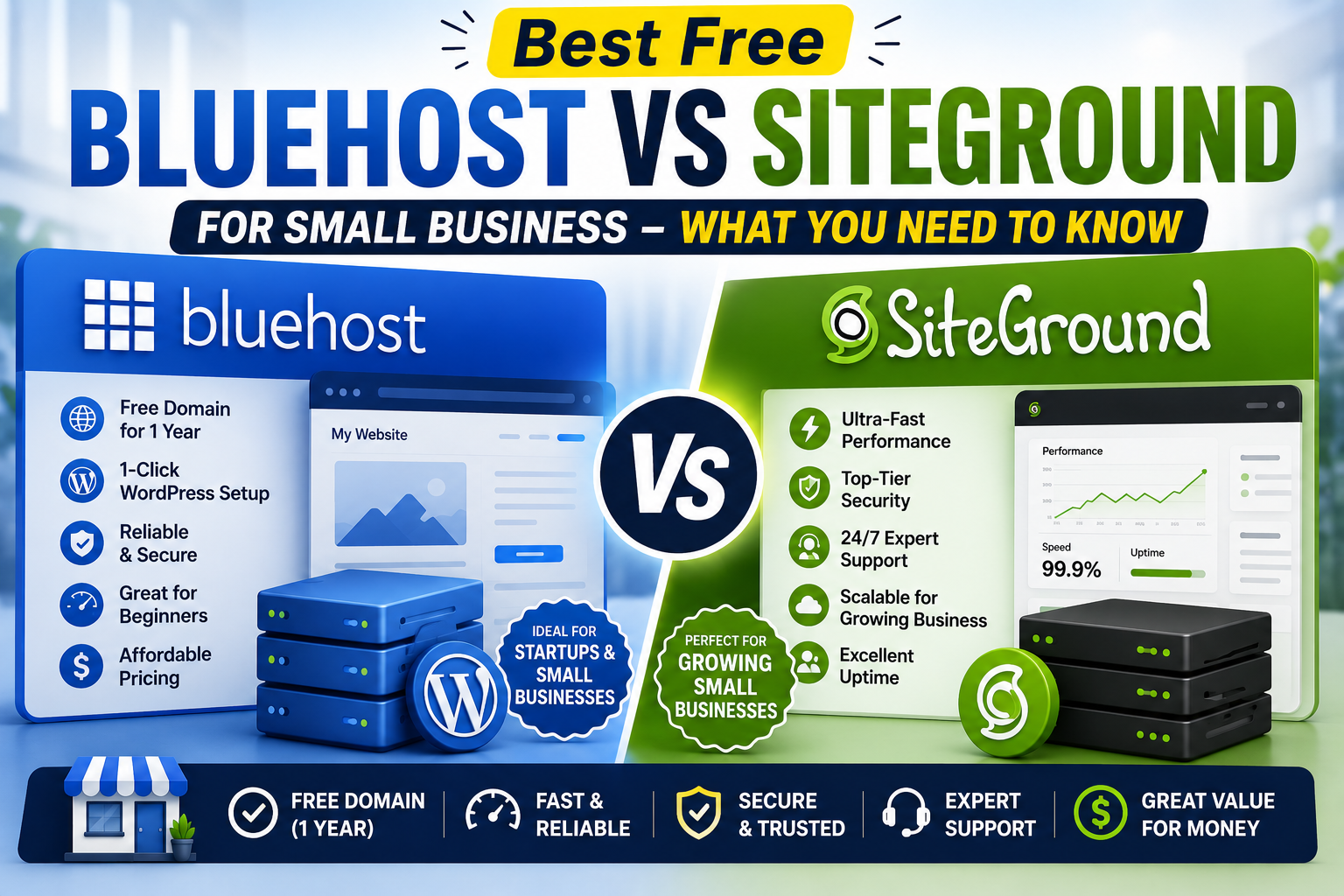
Choosing the best free Bluehost vs SiteGround for small business hosting comes down to one honest question: what are you actually getting for the price — and what hidden costs bite you at renewal? Both hosts are genuinely good. But they’re built for different owners, different budgets, and different growth curves. If you’re launching a first WordPress site on a shoestring, the answer isn’t the same as if you’re running a five-product WooCommerce store that needs to stay online during a flash sale. This guide cuts through the marketing copy and tells you exactly which host wins in each situation — and who should walk away from both.
Key Takeaways
- Neither host is completely free — Bluehost’s introductory price starts as low as $1.99/month (according to its official pricing page), but renews at a significantly higher rate; SiteGround’s entry plan starts at $2.99/month intro, renewing higher.
- SiteGround wins on server performance — its SuperCacher technology and Google Cloud infrastructure consistently draw praise from users on G2 and Capterra for faster load times on shared plans.
- Bluehost wins on beginner-friendliness — the one-click WordPress install and free domain for the first year make it the path of least resistance for a brand-new site owner.
- SiteGround’s storage limits are tighter — the StartUp plan caps storage at 10 GB, which can become a real constraint for image-heavy or WooCommerce sites within 12–18 months.
- Neither host has a truly “free” tier — always check the renewal price, not the launch price, before committing to a multi-year contract.
What Is the Bluehost vs SiteGround Debate, Really?
Bluehost and SiteGround have been the two names small business owners keep hearing since the early 2010s. Bluehost, owned by Newfold Digital (formerly EIG), is one of WordPress.org’s officially recommended hosts and has historically leaned on aggressive introductory pricing to pull in first-time site owners. SiteGround, a Bulgarian-founded company that migrated its infrastructure to Google Cloud in 2020, targets owners who want a bit more under the hood — staging environments, daily backups, and a developer-friendly control panel — without paying for a fully managed host.
⭐ Our top pick for best free bluehost vs siteground for small business
Affiliate link — we may earn a commission at no extra cost to you
When people search for the best free Bluehost vs SiteGround for small business option, they’re usually hoping one of these hosts has a genuinely free tier. Neither does. But both have introductory rates low enough that the distinction barely matters in month one. The danger is month 13, when the renewal kicks in at two to three times the launch price. That’s the pricing trap most comparison articles quietly skip over.
Bluehost’s Basic plan is built for one website. SiteGround’s StartUp plan is also one-site only. Both hosts upsell aggressively — domain privacy, SiteLock security, CodeGuard backups — all of which are bundled into higher tiers or sold as add-ons. Knowing this before you check out is worth more than any coupon code.
The biggest weakness of Bluehost specifically? Renewal pricing transparency. Users on Trustpilot repeatedly flag the gap between the advertised rate and the renewal invoice. That’s the single thing to read the fine print on before you enter a card number.
How Do the Plans Actually Stack Up?
Here’s a side-by-side of the entry-level plans from each host, pulled from their official pricing pages at the time of writing. Prices are introductory unless noted.
| Feature | Bluehost Basic | SiteGround StartUp |
|---|---|---|
| Intro Price | From ~$1.99/mo | From ~$2.99/mo |
| Renewal Price | Significantly higher (check official page) | Significantly higher (check official page) |
| Websites | 1 | 1 |
| Storage | 10 GB SSD | 10 GB SSD |
| Free Domain | Yes, year one | No |
| Free SSL | Yes | Yes |
| Daily Backups | Add-on (CodeGuard) | Included |
| Staging Environment | Higher tiers only | Included |
| CDN | Cloudflare (basic) | Cloudflare (included) |
| Email Accounts | 5 (Basic plan) | Unlimited |
nn
Verdict on paper: SiteGround packs more into the base plan — daily backups and staging are features you’d pay extra for with Bluehost. But Bluehost’s free domain saves you roughly $15–$18 in year one, which matters when you’re bootstrapping.
Speed and Reliability: What Users Actually Report
Performance on shared hosting is notoriously variable. What matters for a small business isn’t a lab benchmark — it’s whether your site loads in under three seconds for a visitor in your target geography, and whether the host stays up during a product launch or a local news mention that sends a traffic spike your way.
According to aggregated reviews on G2, SiteGround users consistently praise its SuperCacher (a multi-layer caching plugin exclusive to SiteGround hosting) for improving WordPress performance without requiring a separate caching plugin. Users on Capterra note that SiteGround’s migration to Google Cloud infrastructure in 2020 noticeably improved reliability on the shared tier.
Bluehost reviews on the same platforms are more mixed. Positive reviews highlight ease of setup; critical ones mention slower response times on the Basic plan during peak hours. It’s worth noting that Bluehost’s shared hosting sits on its own data-center infrastructure rather than a hyperscale cloud provider, which can mean more variability at the lower tiers.
nn[ADD YOUR TEST DATA: Time To First Byte (TTFB) for Bluehost Basic vs SiteGround StartUp, tested from a US location with a default WordPress install]nn[ADD YOUR TEST DATA: Uptime percentage over a 30-day monitoring period for both hosts]nn
Support: The 11 PM Problem
Picture this: it’s 11 PM on a Wednesday. Your checkout page is throwing a 500 error. You’ve got a product going live at midnight. How fast does each host actually respond?
SiteGround offers 24/7 live chat, phone support, and tickets. According to user reviews on Capterra, the live chat queue is typically short outside of peak hours, and agents are reported to have technical depth beyond basic “have you cleared your cache?” responses. Bluehost also offers 24/7 chat and phone support, but a recurring theme in Trustpilot reviews is that first-line agents often escalate tickets rather than resolve them immediately, adding friction in urgent situations.
nn[ADD YOUR TEST DATA: Median live chat wait time for Bluehost support, tested at off-peak and peak hours]nn[ADD YOUR TEST DATA: Median live chat wait time for SiteGround support under the same conditions]nn
Neither host’s support is uniformly bad. Both have published extensive knowledge bases. But if your business depends on fast human escalation, SiteGround’s reputation in the community is stronger on this specific point.
Pros and Cons of Each Host
Bluehost
| Pros | Cons |
|---|---|
| Free domain in year one (saves ~$15–$18) | Renewal pricing is substantially higher than intro rate |
| One-click WordPress install, beginner-friendly dashboard | Daily backups require a paid CodeGuard add-on |
| Officially recommended by WordPress.org | Staging environment locked behind higher-tier plans |
| Introductory pricing among the lowest in the market | Mixed user reviews on support escalation speed |
| WooCommerce-optimized plans available | Shared hosting not on hyperscale cloud infrastructure |
SiteGround
| Pros | Cons |
|---|---|
| Daily backups included on all plans | No free domain — you pay separately from day one |
| Staging environment on the entry plan | 10 GB storage cap on StartUp can fill fast for media-heavy sites |
| Google Cloud infrastructure with SuperCacher | Renewal pricing is steep — among the sharper jumps in the market |
| Strong community reputation for support quality | No phone support on lower plans |
| Custom SiteGround control panel is clean and modern | Can feel over-engineered for a truly simple brochure site |
nn
Who Should NOT Buy Either of These Hosts?
If you’re expecting to run a high-traffic store with several thousand daily visitors, shared hosting from either company will become a bottleneck. Both hosts offer higher-tier cloud and managed WordPress plans, but at that point you’re looking at pricing closer to WP Engine, Kinsta, or Cloudways — hosts purpose-built for that load. Shared hosting is for the 0–500 daily visitor range, not the 5,000+ range.
And if you need email hosting as a core part of your business stack, neither’s base-plan email offering is a substitute for Google Workspace or Microsoft 365. Both hosts provide free business email, but the reliability, spam filtering, and deliverability of those accounts don’t match a dedicated email provider. Don’t anchor your client communications to a shared host’s mail server.
Lastly, if you’ve already outgrown cPanel-style hosting and want Git-based deployments, containerized environments, or server-level SSH access without jumping through hoops, look at Cloudways or DigitalOcean instead. SiteGround is developer-friendlier than Bluehost, but neither is a developer-first product.
How to Choose: The Three Questions That Actually Matter
- What’s your year-two budget? Both hosts look cheap in year one. Pull up SiteGround’s official pricing page and Bluehost’s equivalent, find the renewal rate, and budget against that number — not the intro rate. A plan that renews at three times the launch price is only a bargain if you’re ready to migrate or renegotiate at the 12-month mark.
- Do you need staging and daily backups from day one? If yes, SiteGround’s StartUp plan is the cleaner choice. If you’re comfortable adding a backup plugin like UpdraftPlus and handling staging manually, Bluehost’s lower entry cost makes sense while you’re testing whether the business idea works.
- How much does your domain cost separately? Bluehost’s free domain in year one is a real saving. SiteGround doesn’t include one. For a bootstrapped small business, that $15 gap on day one is meaningful. For an established business migrating an existing domain, it’s irrelevant.
For a deeper look at whether Bluehost’s freebies are genuinely free or just deferred costs, our honest 2026 Bluehost review breaks down every add-on charge you’ll encounter at checkout.
nn[ADD YOUR TEST DATA: Actual checkout total for a 12-month Bluehost Basic plan including all pre-checked upsells at the time of purchase]nn
Final Verdict: Which One Wins for Small Business?
The honest answer is that the best free Bluehost vs SiteGround for small business comparison doesn’t have a universal winner — it has a winner for your specific situation.
Pick Bluehost if: you’re launching your very first site, you want the fastest path from zero to a live WordPress page, and your year-one budget is tight enough that a free domain and sub-$2/month intro pricing genuinely moves the needle. Accept that you’ll either migrate or renegotiate at the 12-month mark.
Pick SiteGround if: you’ve launched a site before, you understand what staging and daily backups are for, and you’re willing to pay a few dollars more per month to have those guardrails built in. The SuperCacher performance advantage and Google Cloud backbone mean your site will likely load faster and stay up more consistently — which matters when a single slow or down page costs you a customer.
Neither host is right for a high-traffic store, a developer-first workflow, or anyone who needs enterprise email. And neither is actually free — a critical point that gets buried in every comparison article that’s more interested in affiliate conversions than honest advice.
The refund window for both hosts is typically 30 days for shared hosting plans — verify this on each host’s terms of service before purchasing, as policies can change.
For a broader look at whether Bluehost delivers on its promises, our Is Bluehost Really Free? Honest 2026 Review covers the fine print in detail.
Frequently Asked Questions
Is there actually a free Bluehost plan for small businesses?
No. Bluehost doesn’t offer a permanently free hosting tier. The confusion comes from its very low introductory pricing (from around $1.99/month according to its official pricing page) and the free domain included for year one. These are discounts, not free products. Renewal pricing is notably higher, so read the full terms before committing to a multi-year plan.
Does SiteGround offer a free trial?
SiteGround doesn’t publish a free trial offer on its shared hosting plans as of the time of writing. It does offer a 30-day money-back guarantee on most plans, which functions as a risk-free trial period — but you pay upfront and request a refund if unsatisfied. Verify the current refund policy on SiteGround’s official terms page before purchasing, as terms change.
Which host is better for a WooCommerce store?
Both hosts offer WooCommerce-specific plans. SiteGround’s WooCommerce hosting includes the same SuperCacher and Google Cloud backbone as its standard plans, which community feedback on Capterra and G2 suggests produces faster page loads for product-heavy stores. Bluehost offers WooCommerce-branded plans with pre-installed plugins. For a store expecting more than a few hundred daily visitors, neither shared tier is a long-term solution — managed WooCommerce hosts become relevant at that scale.
Can I move from Bluehost to SiteGround easily?
SiteGround offers a free WordPress migrator plugin that handles most standard migrations automatically. The migration is typically straightforward for a standard WordPress or WooCommerce site. Complex sites with custom server configurations, heavy database dependencies, or non-WordPress CMS setups may require manual intervention. SiteGround’s documentation covers the migration steps in detail on their official help center.
Pricing and plan limits change frequently. The introductory rates shown in this article may differ from current offers, and renewal prices can be substantially higher than the launch price. Always check the official pricing pages of SiteGround and Bluehost directly before making a purchase decision. This article contains affiliate links — if you purchase through them, we may earn a commission at no extra cost to you.
“

Written by
Nahid Reza · Founder & Lead Reviewer
Nahid tests business software, AI tools and web hosting at AffiliatesMaker - signing up on paid accounts, running real projects, and checking the renewal price and refund window before recommending anything. Vendors cannot pay for a higher score. Meet the team →

